Freezing is the best long-term storage for peptides - but only for the powder (lyophilisate). An already reconstituted (mixed) solution must never be frozen.
Never freeze a reconstituted (mixed) solution. Ice crystals and freeze-thaw cycles destroy the delicate peptide chains; reconstituted vials belong in the fridge - see storage.
How to freeze the powder properly
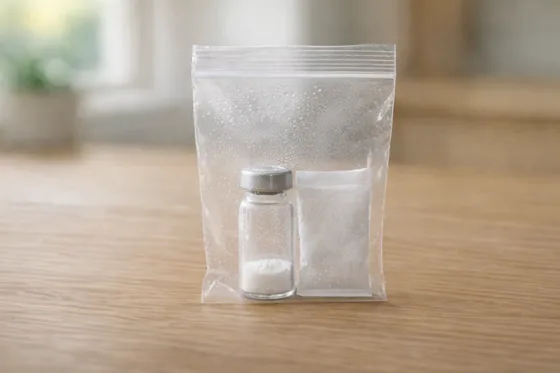
Pack the powder vial airtight together with a desiccant (the lyophilisate is hygroscopic) and store it at −18 °C or colder. It often stays stable for several years. Keep it away from light.
Organise it with a box and a cold pack
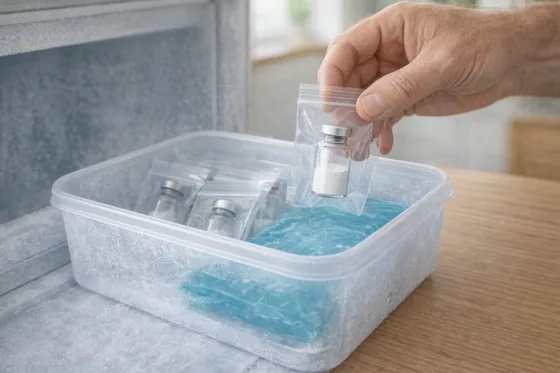
A freezer-safe container with a cold pack works well: place the individually, airtight-bagged vials (each with its own desiccant) upright inside, add the cold pack - itself in a zip-lock bag so it cannot give off moisture - plus a piece of paper towel and a few silica-gel sachets. Several vials stay protected in one place. When you need one, take the box out only briefly, remove one bag and put it straight back; the cold pack cushions the short temperature swing.
Avoid freeze-thaw cycles
Every thaw and refreeze harms the peptide. Do not keep taking the vial in and out; if you store rarely used amounts, split them into portions so you only thaw what you need.
What to watch when taking it out?
Let the frozen vial reach room temperature before opening. Open it cold and humidity condenses inside - and the hygroscopic powder absorbs that moisture. Let it warm up first, then open and reconstitute.
Common questions about shelf life and handling are answered in the FAQ.
Note: Educational information, not medical advice. Many of these substances are experimental and not approved for human use.
Step by step
-
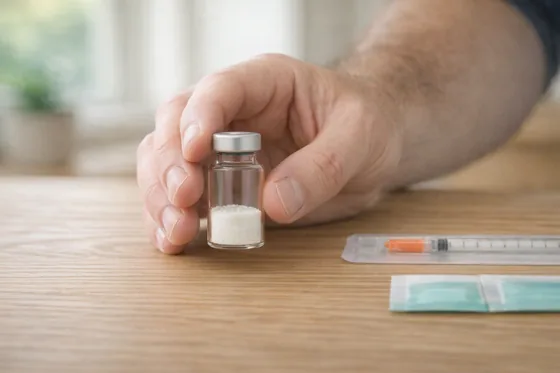 Step 1
Freeze powder only
Only the powder (lyophilisate) belongs in the freezer - never a reconstituted (mixed) solution. -
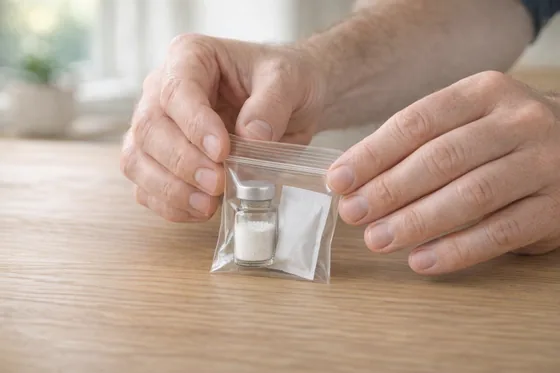 Step 2
Airtight with desiccant
Pack the powder vial airtight together with a desiccant so no moisture gets in. -
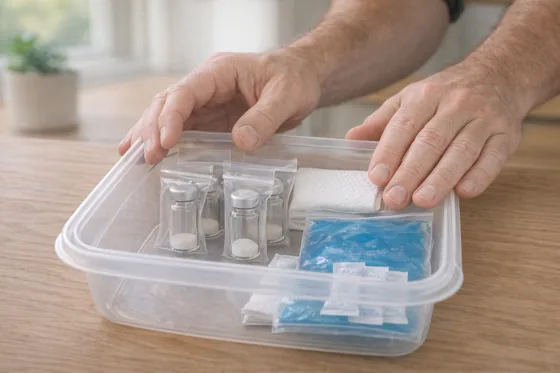 Step 3
Pack it into a freezer-safe box
Put the airtight, bagged vials into a freezer-safe container and add a cold pack that fits inside. Keep the vials upright. So the cold pack cannot spread any moisture, seal it in a zip-lock bag too. Place the cold pack and the vials loosely in the box together with a piece of paper kitchen towel and 2-3 silica-gel sachets.
One box holds several vials - each in its own airtight bag with its own desiccant. That keeps all your stock in one place, so you only open the box briefly to take something out.
-
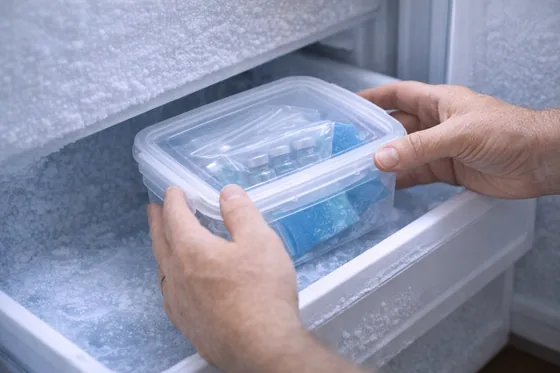 Step 4
At −18 °C or colder
Stored this way the powder often stays stable for several years. Protect it from light. -
 Step 5
Avoid freeze-thaw cycles
Do not take things in and out repeatedly - every freeze-thaw cycle stresses the peptide. When you need a vial, take the box out only briefly, remove one bag and put the box straight back. The cold pack inside the box buffers short temperature swings, so the remaining vials barely thaw.
-
 Step 6
Warm up before opening
Let the frozen vial reach room temperature, then open it - otherwise condensation forms and the hygroscopic powder soaks it up.
Sources
- Bachem - Handling & Storage Guidelineshttps://www.bachem.com
- Peptide handling & storage - Sigma-Aldrichhttps://www.sigmaaldrich.com
- Peptide freeze-thaw stability - PubMedhttps://pubmed.ncbi.nlm.nih.gov